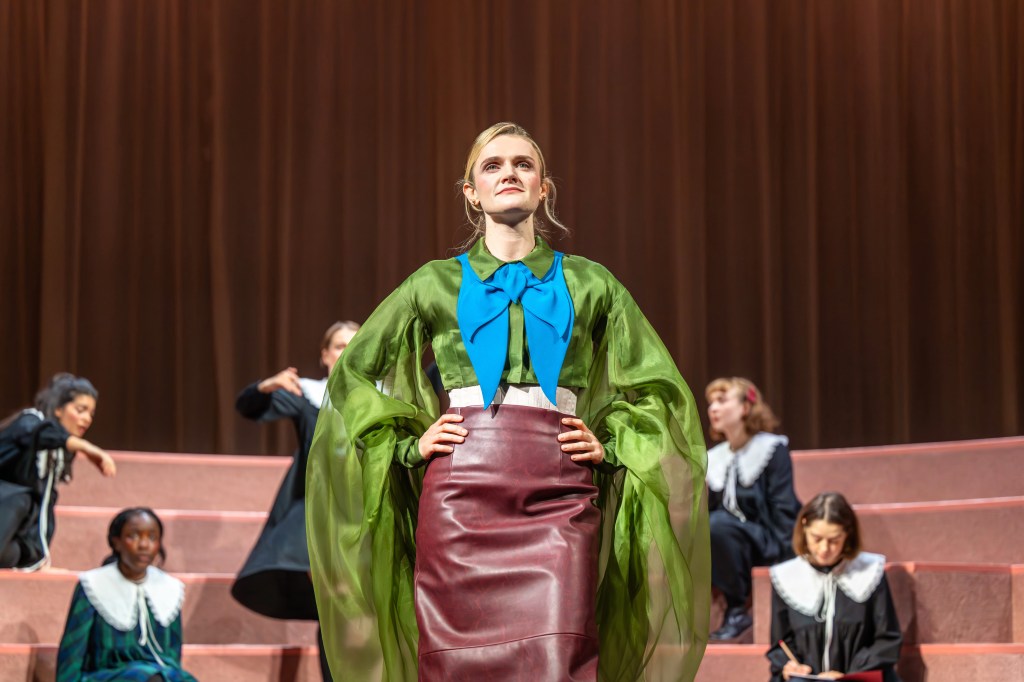
Edinburgh has never been short of characters who believe themselves exceptional, but few have occupied the city’s imagination quite like Muriel Spark’s Miss Jean Brodie, a teacher who regards the classroom as her personal stage and her pupils as an audience waiting to be awakened. In this National Theatre of Scotland production, directed by Vicky Featherstone and adapted by David Harrower, Gayle Rankin is mesmerising in the title role, bringing a vivid, intoxicating energy to a woman whose charisma conceals a darker, more destructive nature.
Rankin makes it easy to understand why Brodie sets her girls’ imaginations alight. She wants them to experience life beyond the confines of their education, opening windows onto art, romance and a world beyond the school. Her theatricality and mischievous wit have two women in the front row laughing throughout this matinee performance. It’s the very qualities that make Brodie so compelling that it contains the seeds of her undoing. She is a self-mythologising figure who mistakes conviction for wisdom, encouraging her pupils to share her romantic admiration for Mussolini and Franco while remaining blind to the consequences of her own political enthusiasms.
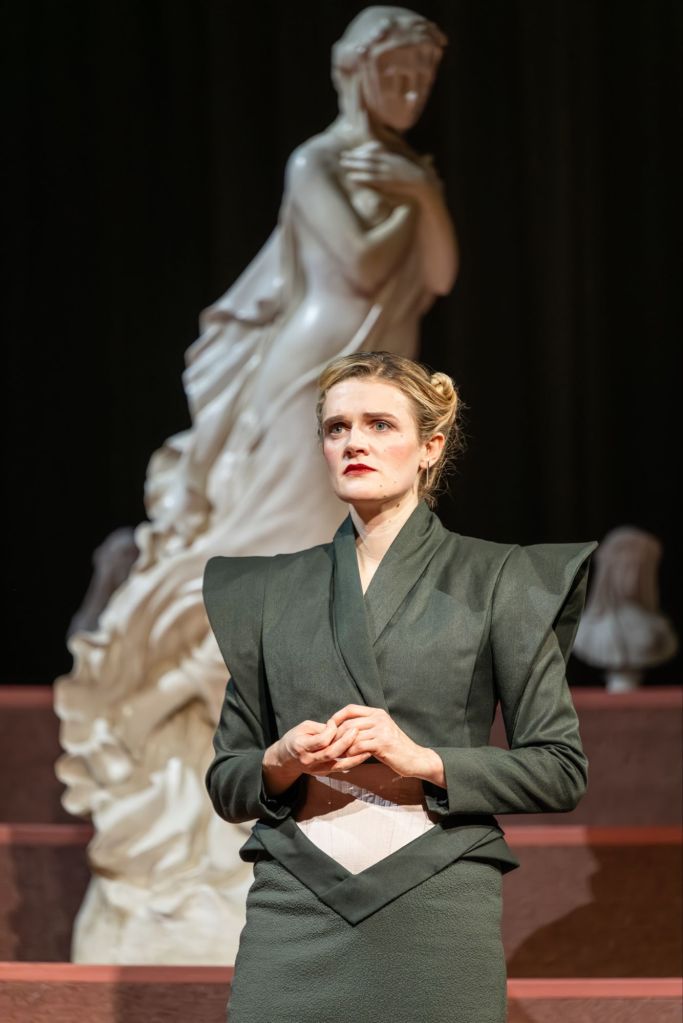
There is something of Jekyll and Hyde in her gradual descent, as the colour and charisma give way to something much darker. Her lack of self-awareness draws her further into an abyss of her own making, unable to distinguish inspiration from possession. Even her insistence that Giotto is the greatest Italian painter because he happens to be her favourite is a revealing moment. Giotto an interesting choice; the problem is Brodie’s certainty that her judgement should be definitive. She wants to awaken the girls to art and beauty, but can’t stop herself from imposing her own ideas into them
Brian Ferguson’s Gordon Lowther, the music teacher in love with Brodie, offers a glimpse of a more conventional life. His home in Cramond becomes a retreat for Brodie and the girls, but when he asks her to marry him, she refuses. Brodie is drawn to romance as an idea rather than its everyday obligations. Maureen Beattie brings welcome sympathy to Miss Mackay, the headmistress who attempts to curb Brodie’s influence. Although she stands as an obstacle to Brodie’s ambitions, Beattie suggests a woman whose concern for the girls is not without merit, she comes across as someone with genuine concern for Brodie before her life spins out of control.
Liberty Black’s Mary MacGregor is playful but treated with cruelty because of a perceived stupidity, and the treatment she receives from Brodie can be difficult to watch through modern eyes. Judged and diminished by those who should be guiding her, Mary seems destined to fulfil the tragic role assigned to her. Black gives her a spirit that pushes back against these assumptions, allowing glimpses of a young woman who is more than the figure Brodie has decided she must become. Bobby Rainsbury’s Sandy Stranger gradually sees through the glamour.
Brodie’s secret desire for Teddy Lloyd, played by Dyfan Dwyfor, becomes entangled with the lives of her pupils, exposing the distance between her rhetoric of liberation and her willingness to use others for her own purposes. Her treatment of Jenny (Shreya Khaund Marshall), drawn into the orbit of these complicated adult desires, reveals the damage that can lie beneath Brodie’s romantic view of the world. Sandy’s eventual betrayal is more complicated than an act of disloyalty: it is also a rejection of the authority Brodie believes she has over her.
Anna Orton’s striking costumes bring fresh theatrical energy to the period setting. One outfit even recalls David Bowie’s Ziggy Stardust look during his 1973 Aladdin Sane tour, which brought him to Edinburgh twice.
The final scene delivers a genuine emotional punch. As Brodie tries to reclaim Sandy, Rankin allows the vulnerability beneath the performance to emerge without diminishing the damage that has preceded it. Sandy may be her betrayer, but she is also a pupil shaped by Brodie’s influence, finally refusing to remain within the role her teacher has written for her. The tragedy is that Brodie can inspire independence but cannot bear it when that independence turns against her. Her prime has been built on the conviction that she is the author of other people’s lives; she cannot accept that they were never hers to write.
Until November 7th
Reviewed by Richard Purden.
Five Stars.






Leave a Reply