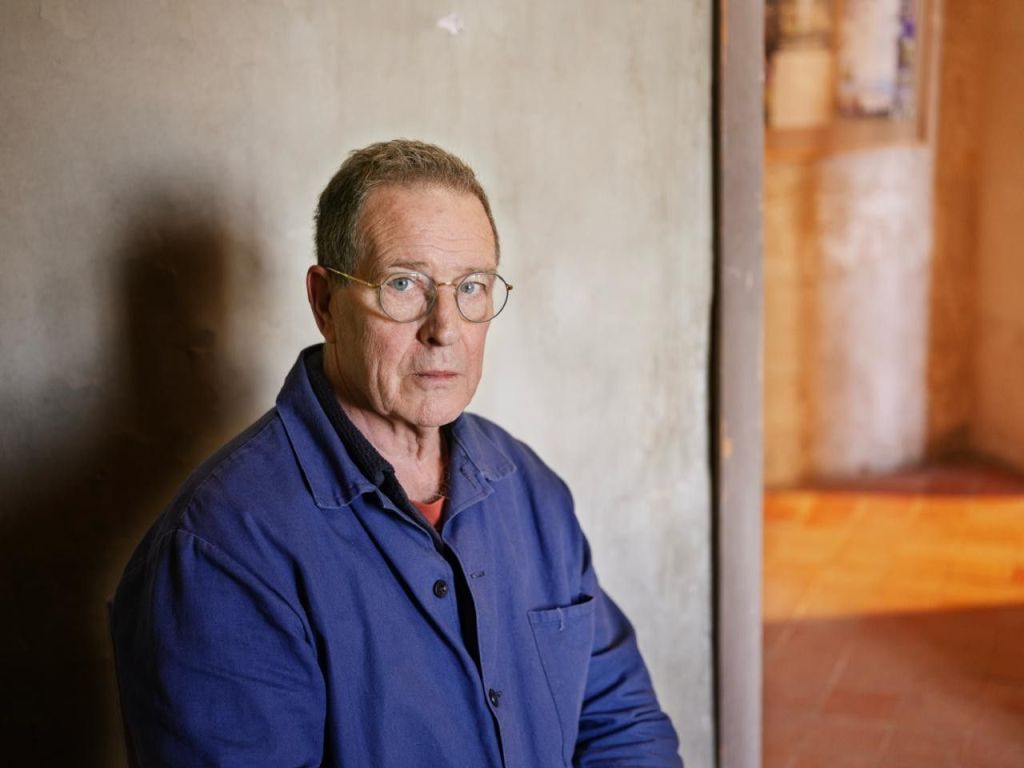
Jack Ellis brings Van Gogh & Me to the Edinburgh Fringe in August 2026. I was intrigued to find out more about the play and have caught up with him before the Fringe madness starts for another year.
When and where are you performing at the Fringe this year?
The piece will be presented in four preview performances at Iffley Village Hall in Oxford, on the 1st and 2nd of August 2026, ahead of its run at the Edinburgh Festival Fringe.
It will then be staged at Dovecot Studios for two previews on 13 and 14 August, followed by its world premiere at the same venue on 15 August until the 30th.
The show will play :
The 13th, 14th at 12:00 PM – free ticketed
The 15th, 16th, 18th, 19th, 20th, 25th, 26th at 12:00 PM
And the 21st, 22nd, 23th, 27th, 28th, 29th, 30th at 12:00 PM & 15:00 PM
What was the inspiration for your show?
Van Gogh & Me began with something very ordinary that then became a life-long obsession. To get the full story, you have to see the play… I give no spoilers!!!
Basically, I was a distracted schoolboy when I first crossed paths with Vincent Van Gogh through my art teacher. I was no good at painting, but I could look, I could listen. And I did. So much so that shortly after, in 1973, I went to the then newly opened Van Gogh Museum in Amsterdam. There, finally in front of the real thing, specifically the Studio of the South section, I found myself in floods of tears. Something weird was happening.
The nine-week period at the centre of this piece is striking because it follows a short, charged, almost impossible encounter between two artists, two temperaments, two visions of what painting, and by extension art, could be. Gauguin arrives in Arles with a fairly defined artistic position, while Van Gogh is still searching for his own. Van Gogh & Me traces how this imbalance leads to the relationship’s deterioration. This period also contains one of the most persistent elements of the Van Gogh myth: the severed ear. Something we all know about, but not its context. The play implicitly asks: what precedes such an act?
Have you performed at any other Fringe Festivals before embarking on Edinburgh?
This will actually be my eighth Edinburgh Festival. My first one was in 1978 at the Canongate with ATC (which I think was known as ATC London at the time). We went back several times after that, and in 1981, we actually created our own mini-festival within the festival.
At the time, what is now the Opera House in Edinburgh was just a hole in the ground. They had plans to build the Opera House, but it took years for anything to happen. So we took over this space, which was literally known as “the hole in the ground”, and built a series of tents and venues there. We called it The Circuit, and it became a little festival within the wider Edinburgh Festival.
After that, I worked at the Traverse Theatre — the old Traverse in the Grassmarket, before it was rebuilt — and performed with ATC. We would do Measure for Measure in the mornings at 10 o’clock, and then in the evenings we would perform something completely different, perhaps a more modern piece. It was an extraordinary experience because you hardly slept. You would finish your evening performance, go out, maybe get a couple of hours’ sleep, wake up for the morning show, rest, and then do it all over again.
You enter a kind of festival time warp. You lose track of what day it is and what time it is; you just know when your alarm goes off and when you have to be at the theatre. It’s incredibly exciting, especially when you’re young and have all that energy.
This time I’m doing the pensioner version of Edinburgh — just one show a day at midday, so I can fit it nicely around breakfast! Although I’ll be doing two shows a day on the Friday, Saturday and Sunday of the second week.
Have you been given any advice or help from performers or creatives who have previously been to the Edinburgh Fringe?
Yes, from John Retallack, with whom I’m returning to the festival after 40 years. One of the most interesting aspects for us will be to see how the festival has changed, especially from a spectator’s perspective, as we’ll also be attending other shows.
John has more experience of the Edinburgh Festival than I do, as he has worked there more frequently. I think he understands the festival better than I do. In our discussions with Dovecot, particularly around developing the venue and deciding where we should perform, John played a key role. He also has a strong sense of timing; I wasn’t sure when to schedule the show, but John did. His experience is greater than mine and has been absolutely invaluable.
What is the best piece of advice about working in Theatre you have received?
Don’t forget to LISTEN.
Who or what inspired you to take to the stage?
I really couldn’t do anything else. It was the one thing I was good at. I was good at showing off at school, and theatre was the one place I truly loved being. Ironically, what I loved most was when you’re on stage. The lights are on you, but when you look out, you can’t see the audience.
And then the irony of that is you’re very enclosed, it’s like a laboratory. The lights are on you. It’s like an operation, you know. You’re just looking at the one thing.
The nice thing about this piece is that it is being played in daylight so I can see everybody, which is actually really quite challenging but also really rather beautiful. I love doing it. So far, so good.
As for what inspired me to go on stage, I had an older brother who was an actor. I remember seeing him, when I was very young, in The Importance of Being Earnest by Oscar Wilde. I found it incredibly exciting, and I was very proud of him. At the same time, I was fascinated by that whole world, the idea of make-believe, of creating things and making people believe them. There’s something remarkable about people saying things on stage and us choosing to believe them. It was the one thing I felt I could do. Sometimes not very well, but you quickly find that out. And when it works, it’s a beautiful feeling. I think there was a certain amount of ego in it at the beginning, there usually is. But eventually you realize it’s not about showing off or being impressive. It’s about truly inhabiting something. It’s an art form.
I’ve never been much of a “personality” as an actor, which seems to be more and more expected nowadays. Many actors are brilliant at that, on chat shows, telling stories. I’ve never been very comfortable or confident with that side of things. What I love is the work itself: figuring out how to use the voice, understanding how a character moves and thinks. The process of becoming someone else has always fascinated me.
When I was 14 I played Corvino in Volpone by Ben Johnson and the man who later became my Art teacher had seen it and asked if I would read the Letters of Van Gogh while he presented a slide show and talk on Van Gogh. This led me to studying Art History at A level where I decided to do my thesis on Van Gogh.
So in a way, one of the very first things I ever performed as an actor was with the man who inspired me to write this play, Kyffin Williams, my art teacher.
Are you planning on seeing any shows this year? If so do you have recommendations?
Of course, I will see as much as I can. I’m on at a very good time, so anything after 4 o’clock I will go and see. But I want to be surprised.
It’s a bit like opening a box of chocolates. Do you look at the menu of what the chocolates are, or do you just pick one and see what it’s like? I want to be surprised.
So I’ll find out when I get there.




Leave a Reply