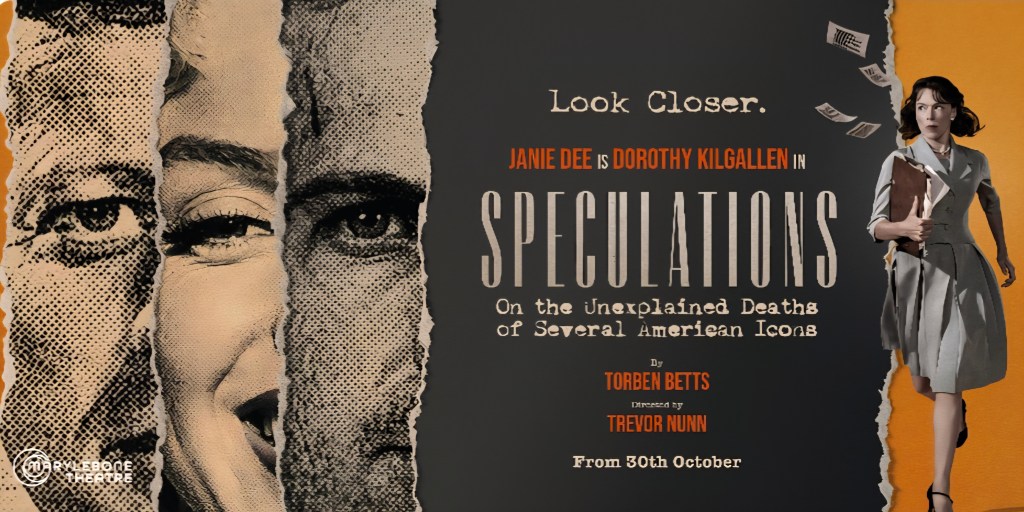
Dorothy Kilgallen was one of America’s most famous journalists during the middle years of the twentieth century. Initially known for her syndicated gossip column, she later turned her attention to some of the era’s most enduring mysteries, investigating the deaths of President John F. Kennedy, Marilyn Monroe and Lee Harvey Oswald. Those deaths, and the conspiracy theories that have grown around them ever since, provide the basis for Torben Betts’ new play, Speculations (or, to give it its rather unwieldy full title, Speculations On The Unexplained Deaths Of Several American Icons).
On Lee Newby’s elegant set, depicting the drawing room of Kilgallen’s New York home, we first find Dorothy (Janie Dee) at her typewriter. A disturbing phone call leaves her visibly unsettled before the arrival of Flo Jackson (Gloria Obianyo), a prospective nanny for Kilgallen’s son. Flo harbours ambitions of becoming a journalist herself and, as the two begin discussing Kilgallen’s latest project, a book examining the links between the deaths of Monroe, Kennedy and Oswald, the play settles into a pattern that it rarely deviates from – Kilgallen and Jackson, discuss the various protagonists and we’re then whisked off to a different location.
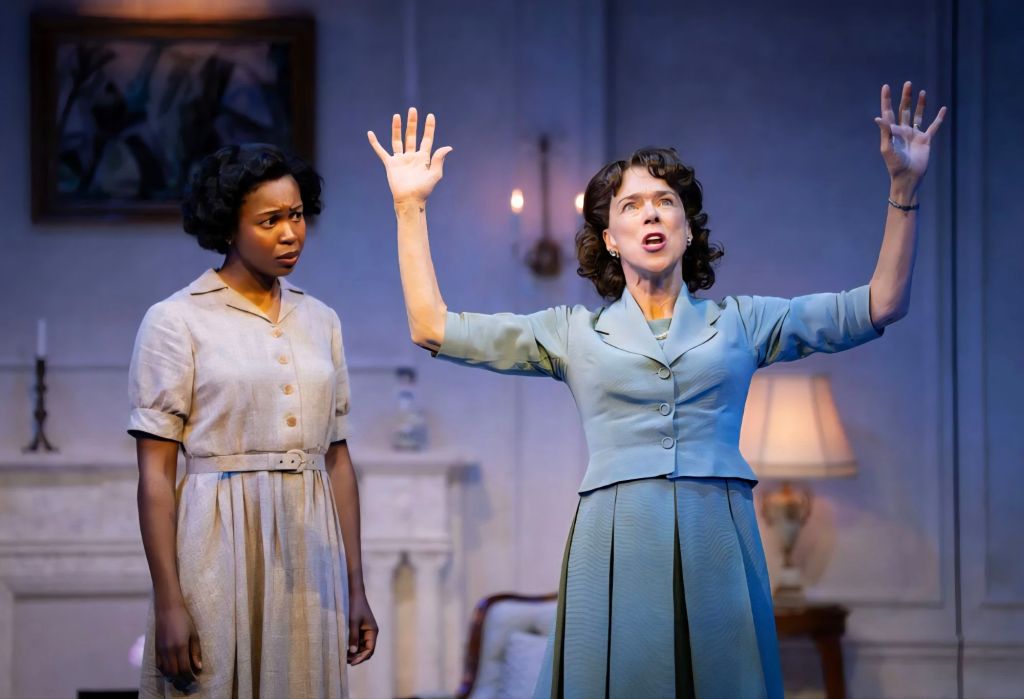
For Monroe’s bedroom, the side wings of the set revolve to reveal Monroe (Natalie Dunne) and Robert F. Kennedy (Jolyon Coy) quarrel over secret diaries, rumours and political intrigue. We then return to Kilgallen’s drawing room for further discussion before the rear wall of the set revolves and transports us to a New Orleans bar, where Lee Harvey Oswald (Joseph Potter) meets mob boss Carlos Marcello (Ferdy Roberts), who attempts to draw him into a plot to assassinate President Kennedy.
And that’s essentially the evening. Scene follows scene, conspiracy theory follows conspiracy theory and while there is certainly no shortage of information, there is precious little drama. Betts’ script is dominated by exposition, with characters repeatedly explaining events rather than allowing them to unfold before us. What should be a gripping exploration of some of modern history’s most fascinating mysteries often feels like a lecture punctuated by scene changes.
The direction doesn’t help itself very much. Much of the action is remarkably static, with characters frequently seated for long stretches of boring dialogue. The structure becomes increasingly repetitive, and the transitions between locations feel surprisingly laborious. The music used between scenes is equally puzzling. Monroe’s real singing voice occasionally accompanies scene changes, jazz (but not of the New Orleans variety) is sometimes heard during the Oswald sequences and at one change Miles Davis is used for some unknown reason. The overall effect feels inconsistent rather than atmospheric.
The decision to give all the characters broadly generic American accents is also curious. Monroe had one of the most instantly recognisable voices of the twentieth century, Robert Kennedy possessed a distinctive Massachusetts cadence and both Oswald and Marcello would have had regional inflections shaped by Louisiana. Stripping these figures of their vocal identities removes a layer of authenticity from a play that asks us to invest in real historical personalities.
In his programme note, director Trevor Nunn writes: “I vividly remember exactly where I was when the news reached this country that President Kennedy had been shot.” So do I – we’re both that old! However many audience members will have no such memory. Over sixty years on, these events belong to history rather than lived experience and the script often seems determined to explain every detail at length and mainly in cliché. The lengthy conversations between Dorothy and Flo about good, evil and morality frequently sound more like a lecture rather than dramatic dialogue.
Trevor Nunn’s distinguished career has produced some remarkable theatre. Sadly, Speculations is unlikely to be counted among his triumphs. There is undoubtedly the material for an absorbing piece here, but not in its current form. Condensed to a taut seventy minutes, it might make an intriguing radio drama; stretched across two-and-a-half hours, including a welcomed interval, it becomes an endurance test.
Perhaps the most telling moment came at the curtain call. In an era when standing ovations are routinely handed out to even the most mediocre productions and on a night when family and friends were in, nobody rose to their feet. On this occasion, the audience’s restraint felt entirely justified.
Reviewed by Alan Fitter.
Two Stars.
Photo credit Helen Maybanks






Leave a Reply