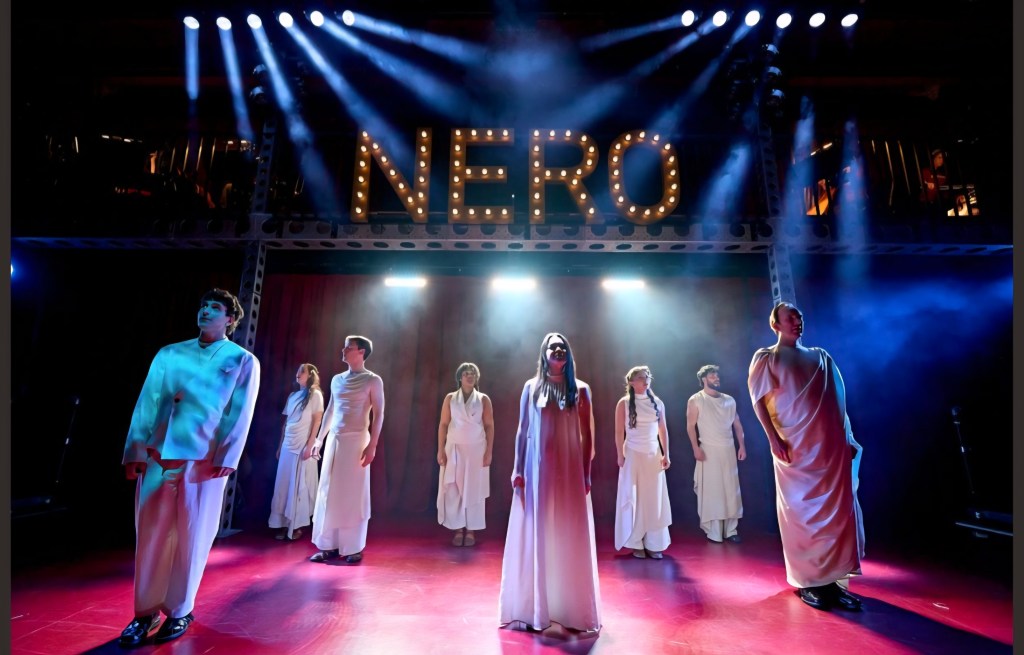
So. Nero. That name in itself is a great title for a musical. And when I walked into the auditorium there it was. Emblazoned in lightbulbs against a plush red velvet curtain. There was also a funereal hush which made me feel as though I had walked into some weird Las Vegas type of cremation service for the great emperor. And then to reinforce that, a piped organ and a harp began playing as Nero himself appeared on the gallery dressed in a pink tutu type dress and sunglasses, introducing us to the band with names such as Socrates and Aristophanes. Yes, I thought; definitely speaking to us from the next world. What a genius concept to have Nero talk to us from the beyond, explaining his actions and orchestrating the presentation of his life as a theatrical MC. One of the first numbers is entitled “Hello Hell” – an excellent way into his world. Except that it wasn’t. It was just a teenage Nero wearing his mother’s dress in some sort of pretend game. His mother Agrippina soon emerged to order him to take her dress off. And therein lies the rub. In the real world the theatrical vaudevillian concept doesn’t really ring true. And even the highly talented Sally Dexter couldn’t pull the rather crass jokes off. Although I have to admit I couldn’t help the odd laugh or two. Especially in the later appropriate satire of American populist leaders.
The portrayal of Nero as the tragic Roman Emperor is a complex task. Even Shakespeare himself didn’t tackle it, although there are some references and quotes from the bard sprinkled through the text with some success. Historically, the story of Nero reads like one of the Greek myths, so it should be ripe material for a theatrical adaptation. The character of Nero leans into that himself by telling us he is more interested in Greek theatre than Roman politics. He would rather be performing at Caesar’s Palace than be a Caesar. Unfortunately, that self-same aforementioned mother is an ambitious Lady Macbeth type, and she seizes the opportunity to rule through her son instead of her late husband. In forcing Nero to marry his sister, the story begins with a wedding, instead of the funeral that I expected.
The Vaudevillian cabaret world presented to us is constantly in conflict with the tragic and violent political world of the time. Of all times, actually. “Although I am a mere boy, I will make Rome great again” Nero says. The words of many are populist political leaders who have grand dreams and allow the ensuing power and adoration to warp those initial idealistic aspirations. When Nero looks up at a huge golden statue that has been erected in his honour, he is horrified and, in ordering it to be destroyed, he adds that the creator and all the slaves who worked on it should be killed. This is the turning point. The Emperor who made himself a leader of the common people has orchestrated his own downfall.
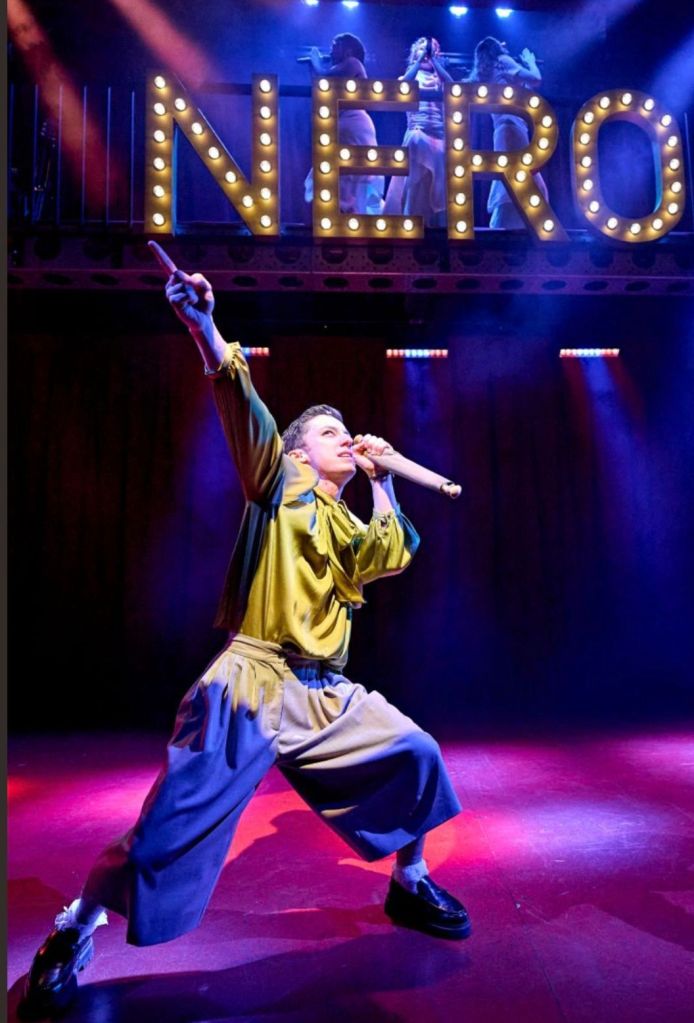
The portrayal of Nero by Andrew Barth Feldman is engaging, full of energy, and often charismatic. We can believe his love of performing, his initial wonder and bewilderment at being Caesar, the easy way in which he falls under the spell of the women in his life: His first wife Octavia played with a vulnerable innocence by Nabi Brown – with haunting vocals to match; the sequinned siren Poppea (the excellent Rhianne-Louise Mccaulsky) giving us the old razzle-dazzle with a sultry soulful voice. And, of course, the marvellous Sally Dexter is playing Agrippina, although I think the book casts her too much as a kind of wicked stepmother. Then, there is the commanding presence of Waylon Jacobs as Tigellinus and the influential Seneca (Stephen Carlile).
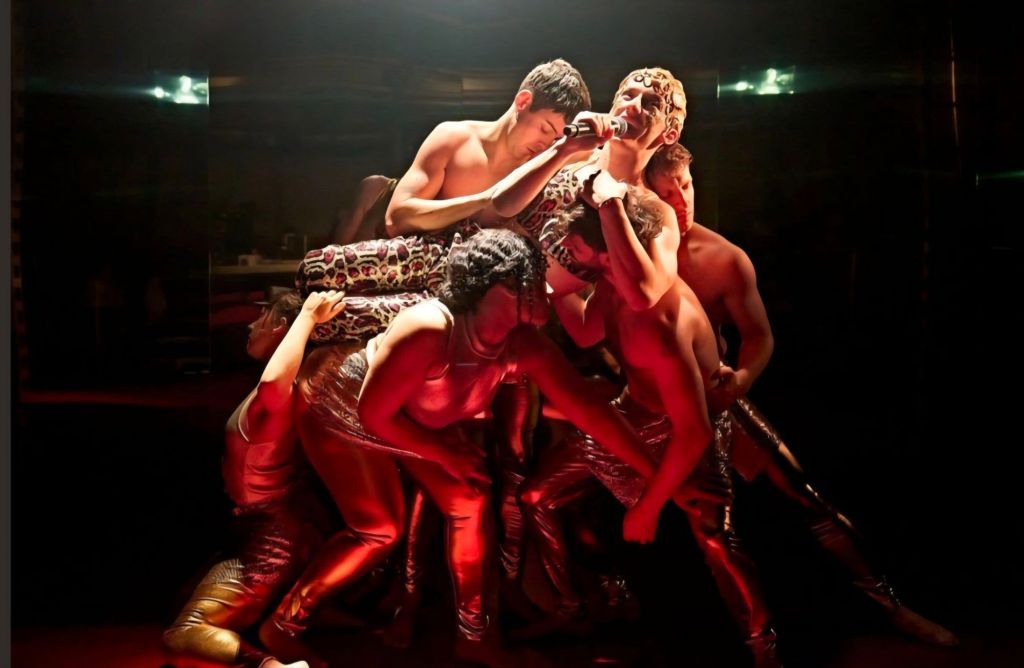
The music is the saving grace. As well as it should be, being composed by the late Duncan Sheik of ‘Spring Awakening’ fame. However, some of the numbers were not fully realised. There seemed to be a lot of reprises and songs not reaching a full conclusion, not helped by some messy choreography, and some ensemble numbers looked as though they had come out of a drama school improvisation class. Whilst some costumes were 80’s glam rock, others looked as though they were second rate dressing up box items. With a more solid framework, this concept could work, though. Without a solid base, the choreography, costumes, staging, and set all come across as workshop ideas.
However, the opening of the second act showed what could be. ‘Nero’s Mind’ was snappy, slick, and mesmerising. Here we had the Rock Star Nero. But this was followed later by more awkward choreography in ‘Ghosts in a Box’. This tango should be sexy and sinister. It came across as a bit of a drama school exercise with half-baked mask work. ‘The lover from Hell’ – between Nero and his mother – could be poignant, but in this storyline, it ended up perplexing. Nero’s agonising ‘And Now he Hounds the Night’ was a standout, but I wanted more. That can be a good thing, but it was very late in the game and certainly was a number that deserves a pre-reprise.
Nero exclaims “What an Artist is locked in me”. True. I think there is a great musical locked away in this first outing. The artistry is just not yet fully realised.
Three Stars.
Reviewed by Linnie Reedman.






Leave a Reply