Władysław Szpilman was born in Poland in 1911 and became a celebrated pianist and composer. When the Nazis invaded, he and his Jewish family were forced into the Warsaw Ghetto, where they endured unimaginable horrors before facing deportation to the concentration and extermination camps. His family was taken, but Szpilman survived, thanks to a combination of his musical talent, the kindness of strangers, and extraordinary good fortune, living to the age of 89. In 1946, he published his memoir, Death of a City, and later renamed The Pianist following the success of Roman Polanski’s 2002 film. Now, almost inevitably, comes the musical, adapted and directed by Thom Sutherland, bringing Szpilman’s remarkable story once more to the public’s gaze.
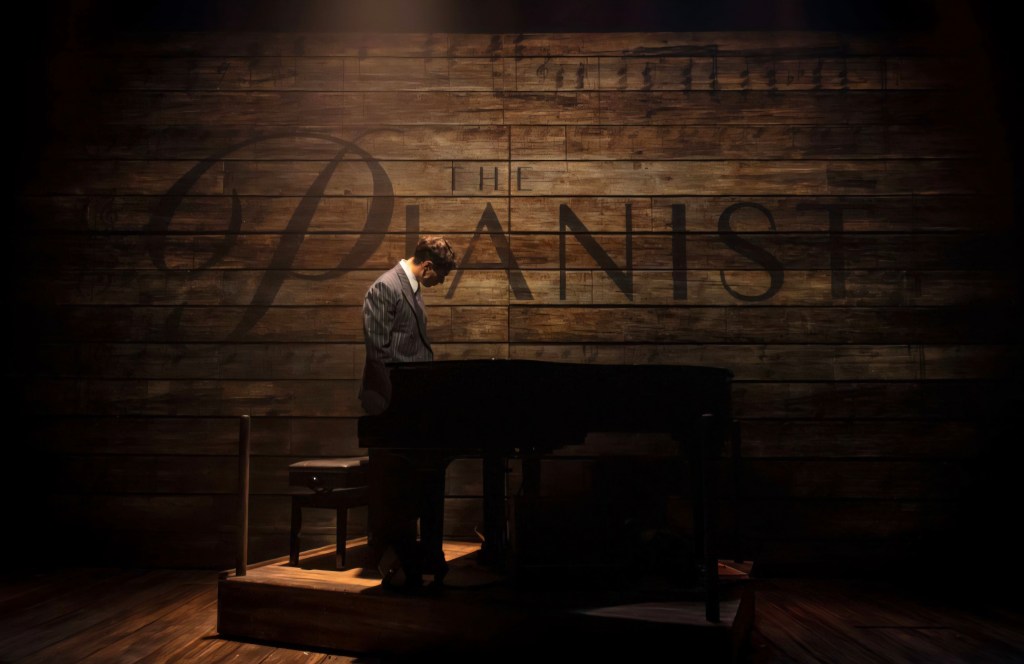
Andrzej Goulding’s brooding set, featuring wooden floors and walls, is dominated by a baby grand piano. Daniel Krikler’s Szpilman enters and begins recounting his life, soon joined by his family: father (T J Holmes), mother (Rosalind Ford), brother Henryk (Nitai Levi) and sisters Regine (Elżbieta Kalicka) and Halina (Melania Maggiore). The stage gradually fills with the bustle of Warsaw, shifting between the family home, the streets, and their favourite café. Krikler narrates directly to the audience while interacting with the characters around him. Life seems good, but then the Nazis arrive in the city, and the atmosphere darkens. Szpilman’s family are taken away to their terrible fate, while he escapes deportation and survives to tell his extraordinary story.
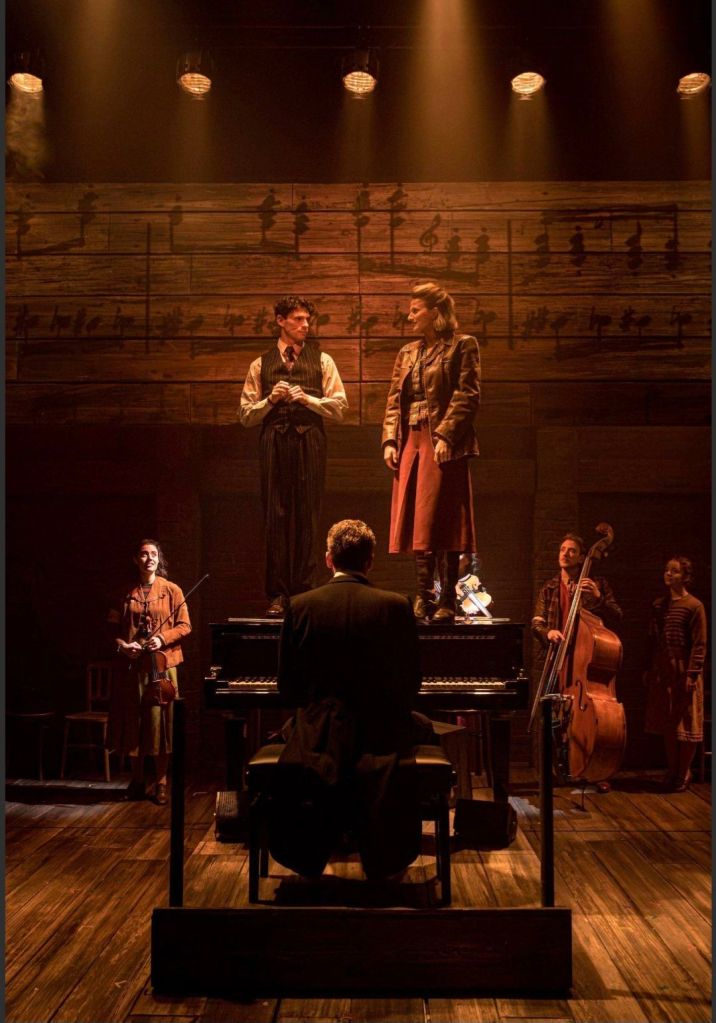
As I said, The Pianist is a musical – well, sort of. Like Stephen Sondheim’s last ever show, Here We Are, The Pianist is a musical of two very different halves. The first act is song heavy with eight songs whilst the second act feels like part play with music, part piano recital as it has only four songs along with instrumentals, from Szpilman and Chopin, a fellow Pole. The music is supplied by the cast of eleven, all of whom are superb actor/musicians although the piano is played mainly by Malcom Forbes-Peckham, who also acts as Musical Director He’s dressed in a formal tailored tailcoat designed along with the rest of cast’s costumes by Jonathan Lipman, which are perfect and add to the production’s atmosphere. The set has to stand in for various locations, and this is achieved by some subtle video design from the aforementioned Goulding.
The problem with what should have been a powerful and moving story of survival against all odds is that everything is a little muted and lacking in emotion. None of the songs move the plot along and are mainly of a similar tempo. The music is written by Szpilman and of its time, but the lyrics are shared – how many people does it take to write the lyrics for a musical – in this case, eight! The performances are all excellent, and it’s always a thrill to see actor/musicians at the top of their game, although Sutherland’s direction lacks a little energy, and the pacing is somewhat plodding at times. Krickler, as Szpilman, is engaging but is mostly emotionless and laid-back, and it makes his story seem matter of fact rather than the spectacular tale it is.
In his programme notes, Sutherland calls The Pianist “a story about compassion, courage and the moments of kindness that can change the course of a life”. It is indeed all those things and more – I just wished it would have been told with a lot more emotion and empathy. This kind of incredible narrative should make you laugh and shed a tear or two – I’m afraid, The Pianist failed to do either for me.
Three Stars.
Reviewed by Alan Fitter.






Leave a Reply