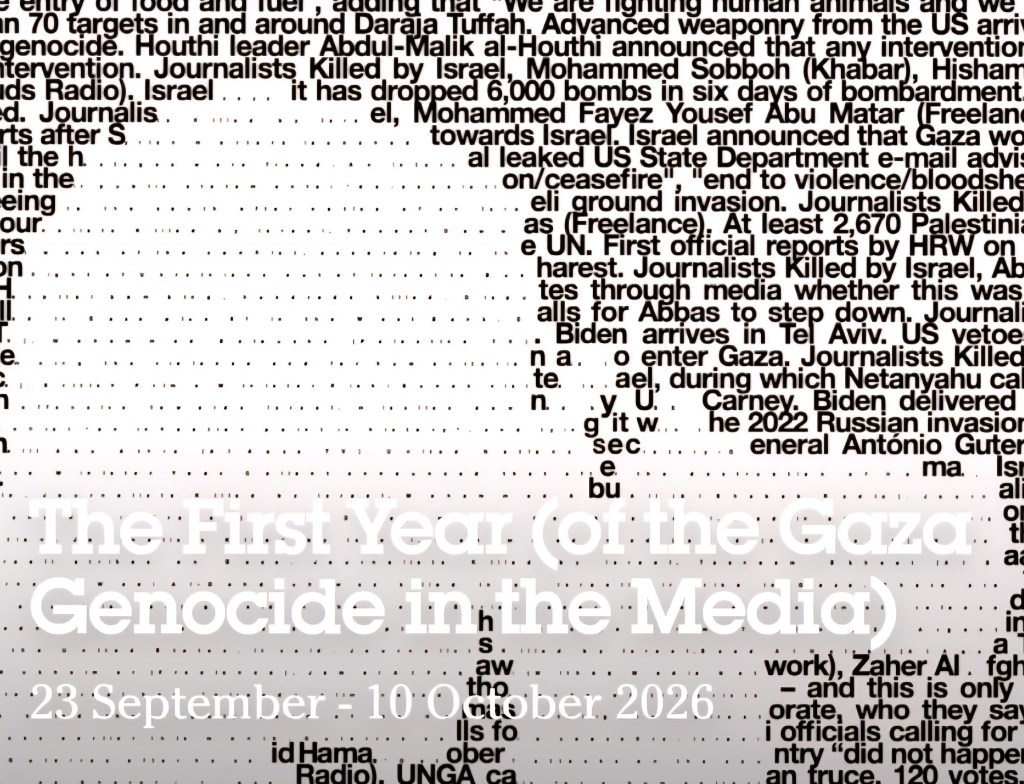
Béznă Theatre is a theatre collective committed to the use of theatre to ‘promote empathy, empower audiences, and inspire change’. Their latest production, on at the New Diorama Theatre until 10th October, is entitled The First Year (of the Gaza Genocide in the Media). It is presented by a powerful and committed ensemble of Palestinian actors, it employs impressive video-scenography to transmit names and statistics in a continuous stream, it challenges its audience’s lack of knowledge, it is fiercely contentious.
The actors present a series of sketches, verbatim presentations of interviews, and a recitation of facts regarding deaths and destruction in Gaza by the Israeli army. The facts are un-nuanced, un-referenced, and unchallenged. It depends quite a lot on the audience’s pre-disposition how convincing they are.
This is not to doubt the sincerity of the performers or the production. But in an environment that bombards anyone sentient with multiple conflicting accounts of the events, it is essential to question. Indeed, the thrust of the production is “Don’t trust what the media are telling you” And a proliferation of alternative explanations and descriptions.
This type of agit-prop theatre has its roots in Brecht and the Berliner Ensemble, and there too was a conflict of comprehension – “Question everything, demand the truth, and also believe all the things this production tells you.” It is a difficult juggling act. It isn’t clear to me how well the theatre works as a source of information. Without time or opportunity for checking facts, the facts become a sort of information barrage that leaves its audience feeling swamped and overwhelmed.
The presentation of facts is the backbone of the drama. Rather less contentiously, the performers are all engaging, dynamic, and well-directed by Béznă Theatre’s co-founder Sînziana Cojocărescu. Some of the dialogue gets lost despite the use of mics, but there is an urgent physicality to the performances that makes the show gripping and commands attention.
Two scenes in the show stand out. The first is a gruelling and compelling piece of eye-witness testimony, describing first an assault by Israeli commandos to effect the rescue of a number of hostages, and second the devastation wrought on the people in the town the commandos attack. The dialogue describes in graphic detail the murder of two hundred Palestinian civilians, and vividly describes the reaction of a mother coming back from market to see her three young daughters ripped apart by explosions. The mother also sees one of the Israeli hostages, freed by the raid, escaping in a helicopter, and she describes her as a pig. There is then an extensive and wholly convincing episode outlining the shock of western observers to the use of such a descriptor – they are outraged by the destruction but find the epithet upsetting. The skewering of the responses of a western audience strikes home.
The second scene for commendation entails the one male actor, buttoned up in a three piece suit and tie for the majority of the show in order to represent officialdom, stripping off jacket and waistcoat and tie, untucking his shirt, and launching into a vigorous performance of the Alabama 3 song Woke Up This Morning, with its inevitable echos of Tony Soprano driving down the New Jersey turnpike. It isn’t clear quite how this relates to the rest of the show, but it’s fun and unexpected, and goes some way to leaven the grinding impact of the preceding performance. The Alabama 3 original features a spoken interlude – ‘when you woke up this morning, everything was gone […] Don’t you wish you didn’t function? Don’t you wish you didn’t think?’
That might be a fitting epigraph for this piece of theatre – necessary, gruelling, difficult to process. But no-one said theatre had to be easy.
Three and a half Stars.
Reviewed by Chris Lilly-October 2026.



Leave a comment