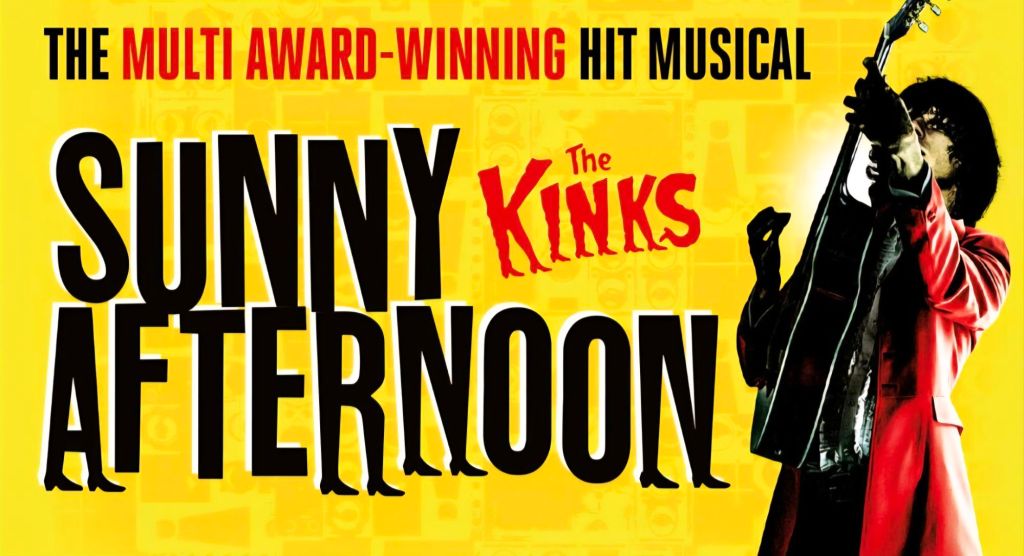
It seems increasingly unlikely that The Kinks will ever reunite. Ray Davies is now in his eighties and younger brother Dave Davies is not far behind. Sunny Afternoon, then, may be the closest audiences will come to experiencing the energy, tension and raw power of one of Britain’s most influential bands.
At Edinburgh Playhouse, the production captures not only the swagger of the band’s rise but also the warmth of its beginnings. Before the fame, lawsuits and exhaustion, the Davies brothers are shown making music in their modest north London home alongside their parents and sisters. There is little money, but an unmistakable sense of joy.
Danny Horn takes on the role of Ray Davies with understated confidence, looking every inch the sharp mid-60s frontman in black roll-neck, sideburns and Chelsea boots. Olivier Hoare embraces the chaos and charisma of “Dave the Rave”, playing the younger Davies brother with wild-eyed energy and aplomb.
Zakarie Stokes as drummer Mick Avory and Harry Curley as bassist Pete Quaife provide both the rhythmic backbone and much of the show’s humour. The pair are excellent comic foils, helping balance the growing tensions surrounding the band’s success.
The standout family sequence comes during Dead End Street, as Ray grabs a washboard and the Davies household erupts into music and dance. Under Adam Cooper’s lively choreography, the scene captures the warmth and humour at the heart of the band’s origins, even as hardship hangs over the family home.
The production truly ignites with You Really Got Me. After two disappointing early singles, Dave Davies famously slashes his amplifier speaker, and suddenly that distorted riff crashes through the theatre with thrilling force. Inside the Playhouse, you can feel the significance of the moment. The song would not only send The Kinks to number one in September 1964, but lay down a blueprint for generations of hard rock and heavy metal that followed.
As the production develops, the emotional cost of fame begins to emerge. Dave struggles with the relentless touring schedule in America, growing increasingly homesick after marrying and becoming a father. Yet the band’s fractious relationship with the United States arguably became a creative blessing for Ray Davies. While many of their contemporaries drifted towards American influences, Davies instead turned inward, documenting British life with wit, melancholy and sharp social observation.
At the same time, this period marked a remarkable evolution in his songwriting. Tracks such as A Well Respected Manshowcased Davies’ ability to satirise class, conformity and suburban aspiration, helping establish The Kinks as chroniclers of a changing Britain rather than simply another successful rock band.
The show also captures Ray’s growing frustration with the business side of the music industry, as management disputes and financial exploitation increasingly overshadow the excitement of the band’s early success.
What Sunny Afternoon captures particularly well is that The Kinks were never simply a vehicle for Ray Davies’ songwriting. When Waterloo Sunset gradually comes together on stage, the production shows how essential each member of the band was to its magic. Alongside Ray’s wistful and observational writing is Dave Davies’ electric guitar work — ferocious when needed, yet equally capable of restraint and elegance. Pete Quaife’s melodic bass lines are also given room to breathe, and watching those musical elements lock together becomes one of the production’s great pleasures.
What ultimately lifts Sunny Afternoon beyond straightforward nostalgia is the enduring relevance of The Kinksthemselves. Their songs still feel deeply connected to British life — full of humour, melancholy, class tension, and everyday observation. More than a celebration of familiar hits, the production reminds audiences why the band’s music continues to resonate generations later.
Reviewed by Richard Purden.
Five Stars.






Leave a Reply