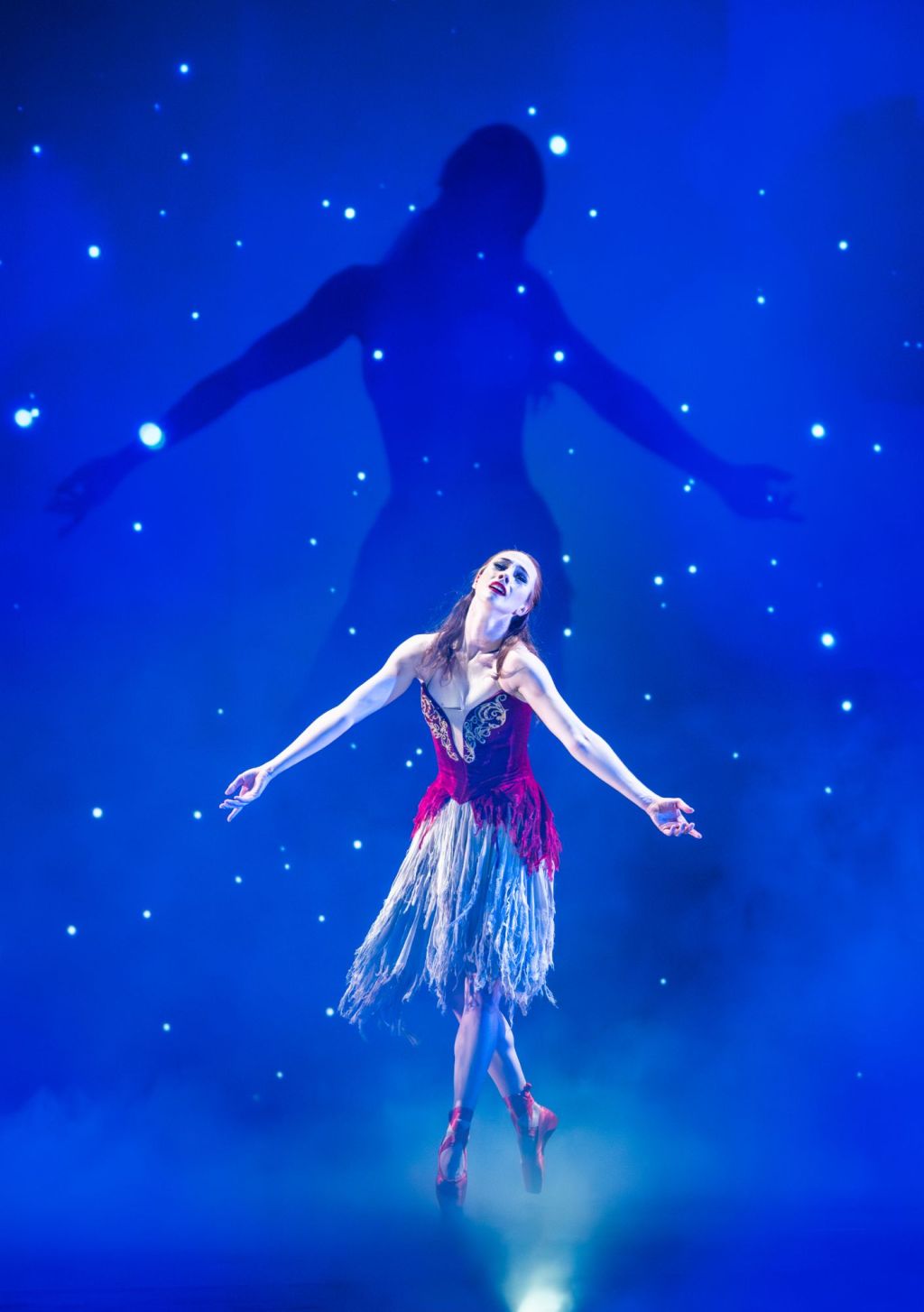
At Edinburgh’s Festival Theatre on Tuesday night, the production played to a packed house, the sense of anticipation in the auditorium palpable before the curtain had even risen.
Matthew Bourne’s stage adaptation of The Red Shoes arrives as part of a long lineage. The original film by Michael Powell and Emeric Pressburger was a jolt to post-war audiences. Its saturated colour and heightened theatricality cut through austerity Britain. Cinema lingers in Bourne’s production. Part of his skill lies in how he transforms those inherited images into something that becomes his own. Colour and design are not surface decoration; they shape the structure of the work. Lez Brotherston’s sets and costumes shift with an other-worldly fluidity and energy that moves us back in time; it is both exhilarating and disorientating.
Much like the original film, the production is threaded with moments that feel haunted, gothic and deeply uncanny, images that stay long after the performance ends. We are invited to consider the pull of the shoes as a force in itself, and what it means to suffer for art.
The music of Bernard Herrmann runs through the production, echoing the tension from his work with Alfred Hitchcock and later Martin Scorsese’s Taxi Driver. That connection is not incidental; Scorsese, more than most, helped restore the reputation of Michael Powell and Emeric Pressburger at a time when their work had fallen out of critical view. By then, The Red Shoes had settled into cult status, admired but no longer central. There was real public disdain for Powell and Pressburger, but Scorsese’s advocacy helped bring work such as The Red Shoes back into focus for a new generation.
That influence doesn’t stop at the cinema either. Matthew Bourne’s idiosyncratic vision comes from his background as a young, working-class East Londoner absorbing culture and developing a fascination much like Scorsese. Kate Bush drew directly from its imagery for her 1993 album The Red Shoes, where the title and visual language clearly echo Powell and Pressburger’s original film.
It is impossible, too, to separate the production from Scottish actress and real-life ballerina Moira Shearer, who played Vicky Page. With her red hair, crimson lips and control of movement, she gave the role a physical identity that still defines it. Ballet, at that point, still carried a sense of distance for many audiences. Cordelia Braithwaite brings the iconic role to life, a difficult task when the performance has already fixed its image in place. She was also an original cast member before the tour was halted by COVID.
Matthew Bourne also amplifies the idiosyncrasies of the ballet world; its glamour and volatility, its imperious directors and driven performers, all circling obsession, fascination, temptation and the consuming pull of art.
The production moves across Monte Carlo, the East End of London, Covent Garden and Paris, each shift coming with cinematic ease. A sense of motion is reinforced through video projection. In one spellbinding sequence, wind-whipped trees fill the stage, the natural world bleeding into choreography and blurring what is real and what is constructed. Cinema lingers, and Bourne’s strength lies in how he gathers those fragments and reworks them into something that feels fully formed in its own right. It’s hard to imagine anyone else other than Bourne bringing this work to life for a modern audience, the working-class East-End Londoner from outside the system, much like Italian-American Scorsese provides a very different perspective.
Matthew Bourne has, perhaps without forcing it, drifted back towards the darker moral centre of Hans Christian Andersen’s original tale, where we are reminded that the red shoes are not a gift, but something closer to compulsion. That also feels like a Scorsese instinct and that idea runs through every iteration of the story: Andersen’s fable, The Red Shoes, and the shifting reputation of the work around it.
There is something recursive about it, the film dismissed and later reclaimed, its makers pushed out and brought back in again, and Moira Shearer, the reluctant centre of an image which she felt ruined her career. She called the making of the film “a miserable experience.” One story around and inside The Red Shoes folds into the next and the next. Bourne captures that unease where performance and art stop being a choice.
Five Stars.
Reviewed by Richard Purden.





Leave a Reply