
Euripides wrote two plays about Iphigenia, well, two that have survived. The first one, Iphigenia at Aulis, is the main source of Serdar Bilis’ adaptation. It concerns King Agamemnon and his grisly solution to the becalming of the ships he wants to go to Troy. His priests say he has to make a sacrifice to appease whichever god is withholding the wind, and the creature he has to sacrifice is his oldest daughter Iphigenia. The play unfolds in conversations between Agamemnon, Iphigenia, and her mother Clytemnestra; Clytemnestra doesn’t see a becalmed fleet as a sufficient reason to murder their daughter. A 21st century audience will almost certainly agree with Clytemnestra.
This is, in brief, the problem that Greek tragedies face in contemporary productions. The balance of necessities, of duties, of observance, that make up the arguments that preoccupied Greek tragedians, have no balance in the minds of today’s audiences. Should Agamemnon sacrifice his daughter? No. End of. If he goes ahead with the killing it’s because he’s monstrous. Euripides didn’t think he was monstrous, he thought he was conflicted.
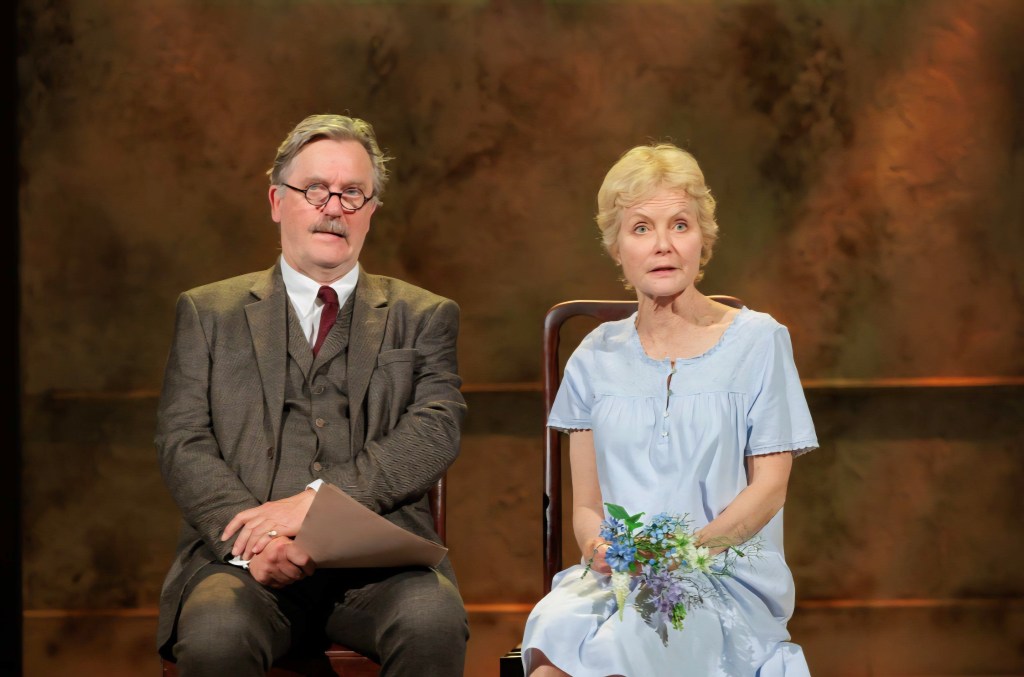
The beautifully designed play (Mona Camille, set and costume) provides commentary on the play through a series of video presentations – women discussing their childhoods and their relationship with their fathers. The cast break character so that the three actors can discuss their own family histories. It’s a very current solution to making very old plays speak. The problem is that it reinforces the imbalance. Agamemnon is nothing more than an abusive man. Euripides thought he was more than that.
The three actors (Simon Kunz as Agamemnon, Mithra Malek as Iphigenia, and Indra Ové as Clytemnestra) are all excellent. Clytemnestra’s distress and desperation is the emotional crux of the play, and Indra Ové gives her grief full weight. Simon Kunz has a fourth-wall breaking moment of engagement with the audience, which is indeed engaging, but when he becomes full Agamemnon, that closeness and sympathy is gone. That is a consequence of the adaptation, not of Mr. Kunz’ acting, but it puts his character at a disadvantage against the emotional resonance of the women’s interaction.
This is a well-considered, well-constructed play, giving a modern twist to a very old play. It is well designed, well directed, and excellently performed. It isn’t quite Euripides, but then perhaps that isn’t possible two thousand years down the line.
Runs until 2nd May 2026.
Three and a Half Stars.
Reviewed by Chris Lilly.







Leave a Reply