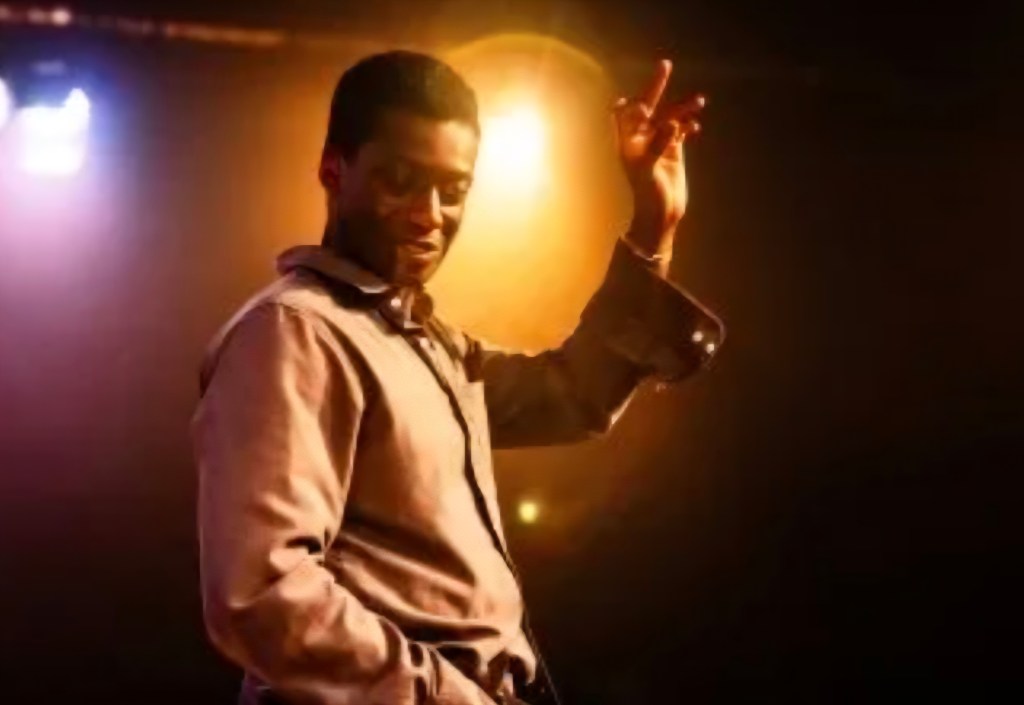
Miles Davis remains jazz’s great modernist: a musician who changed the sound of the 20th century several times over, and did it with a glare, a whisper and a horn tone that could make time feel elastic. Kind of Blue is the untouchable monument – the album that somehow manages to be both the genre’s best-known calling card and its most enduring work of art. Oliver Kaderbhai’s new play, Miles., takes its cue from both, and sets out to bottle that lightning on stage.
The play’s framing device is that we’re in Columbia’s 30th Street studio in New York – the converted church where Kind of Blue was recorded in 1959 – but the year is 2026. A young musician, Jay (Jay Phelps), is listening to the session tapes when he is joined by the ghost of Davis himself (Benjamin Akintuyosi). The apparition is not benevolent; Davis arrives irascible, impatient, and immediately critical: Jay (who he insists on calling Dave) is playing too many notes, and the wrong ones anyway. From there the play slips back and forth through time, interweaving Davis’s life with the assembling of the legendary band: John Coltrane, Cannonball Adderley, Bill Evans, Jimmy Cobb and the rest.
Davis’s biography, as the play reminds us, is not short of incident. There is the Paris romance with Juliette Gréco; the descent into addiction; the sexual swagger; the desperation and ugliness of hustling for the next fix; and, threaded through everything, the racism that shaped the world he moved through. It is a life of brilliance and brutality, with Davis often both victim and perpetrator.
Akintuyosi does not impersonate Davis so much as inhabit him. The look is uncanny, the rasp in the voice convincing, and the presence unmistakably that of a man who expects the room to rearrange itself around him. Phelps, whose concept this is, plays everyone else: Clark Terry, Charlie Parker, Dizzy Gillespie, and more, while also delivering superb trumpet playing. Their double act is the production’s great pleasure – two performers sparring, listening, needling, pushing.
There is, however, one curious staging misstep: Akintuyosi briefly steps out of Davis to play the young Miles’s teacher while Phelps becomes a back-turned teenage Miles. It is hard not to feel this should have been swapped, allowing Akintuyosi to remain anchored as Davis throughout.
Kaderbhai directs his own script with assurance. Ellie Wintour’s set is striking: a baby grand sits centre stage on a gleaming circular floor that catches the light representing a vinyl record album. Archival video appears throughout, though projections onto a slatted dark-wood backdrop often render faces frustratingly indistinct; the most effective moment comes when Gréco’s image is thrown directly onto Davis’s vest.
Yet for all its craft, Miles. at times feels more like an illustrated lecture than a piece of theatre. The central problem is one of dramatic temperature: too much telling, not enough showing. Scenes of genuine tension are rare, and the script can get lost in esoteric musical talk – diminished thirds, augmented twelfths – and dutiful explanations of supporting players, at the expense of the man at its centre.
Miles Davis was an amazing musician and an incredibly interesting man and whilst Akintuyosi captures him perfectly, I’m not sure the play does. Another of Davis’s great albums was Sketches Of Spain and in Miles., we seemingly only get sketches of the man.
Reviewed by Alan Fitter.
Three Stars.
Photo credit: Colin J Smith.
https://southwarkplayhouse.co.uk/productions/miles/
Director and writer
Oliver Kaderbhai
Original concept
Jay Phelps
Set and costume designer
Ellie Wintour
Lighting designer
Alex Lewer
Sound designer
Will Tonna
Projection designer
Colin J Smith
Cast
Miles, Elwood Buchanan – Benjamin Akintuyosi
Jay, Charlie Parker, Dizzy Gillespie, Clark Terry, Miles’s Father – Jay Phelps




 Theatre, Art and Film Reviews
Leave a comment