
Even as a 15-year-old reading The Merchant of Venice for O levels, I felt that Shylock was unfairly treated although I did not fully understand the concept of antisemitism then.
Antonio, a merchant, borrows money from Shylock to help his friend Bassanio court Portia. Shylock’s daughter, Jessica dreams of escaping, marrying Lorenzo and converting to Christianity. She elopes, taking valuables, while Shylock agonises about his losses. Antonio can’t repay the loan, and Shylock demands a pound of his flesh as agreed. The heiress Portia, now Bassanio’s wife disguises herself as a lawyer and saves Antonio. Shylock forfeits his wealth and is forced to convert to Christianity.
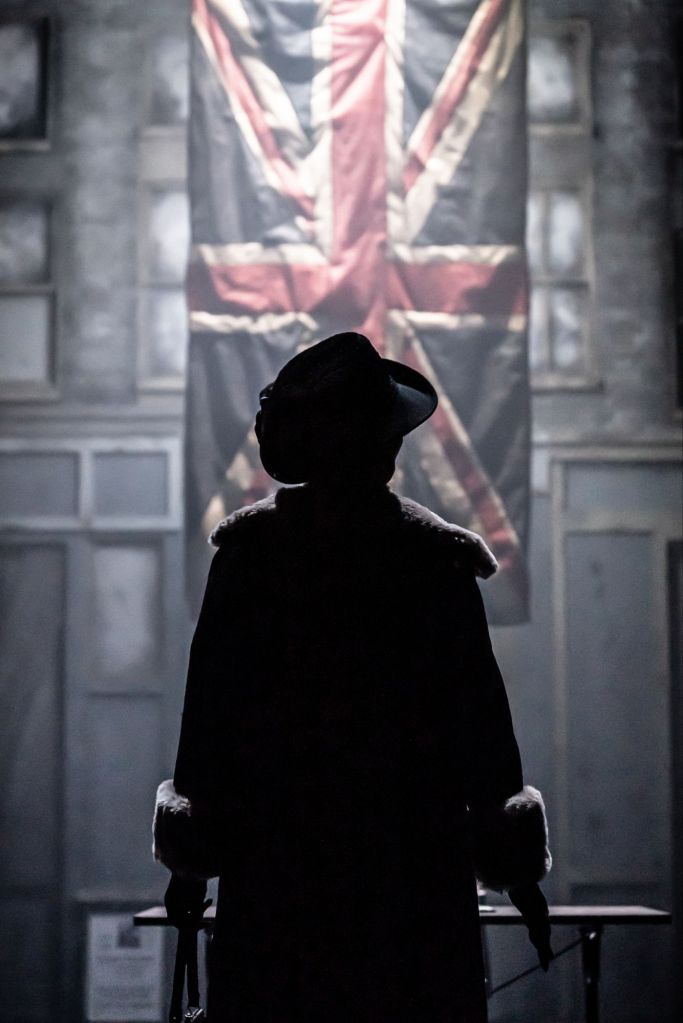
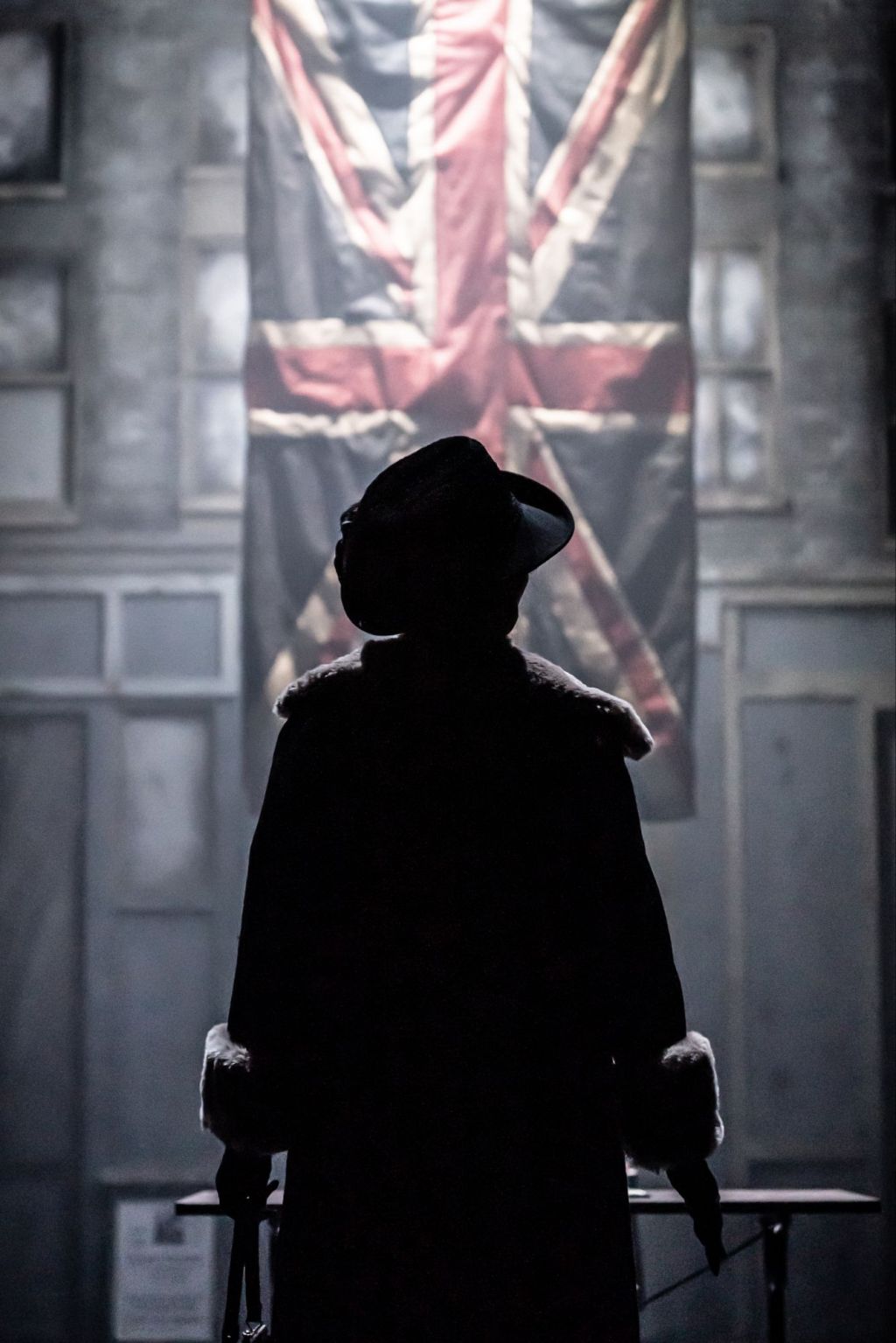
Tracy-Ann Oberman and Brigid Larmour have adapted and heavily edited the original with Shakespeare’s money lender, now female, living in the 1930s amid the rise of Oswald Mosley’s Blackshirts. The costumes reflect the era with the protagonists dressed in black with red armbands.
The back of the stage features an East End Street which was also used as a blank screen for displaying historical images or film footage of the British Fascist Union and Oswald Mosely. The sound and lighting effects create an impression of an edited live-action film.

Antonio (Joseph Millson) is an arrogant, abusive Blackshirt while Portia (Georgie Fellows) is a spoilt and stylish socialite. Xavier Starr is suitably offensive as Gratiano drunkenly singing patriotic songs and urinating in a Jewish doorway.
Oberman’s Shylock is portrayed as a matriarch and pawnbroker who experiences hostility and discrimination from important individuals.
Her character encounters verbal abuse and antisemitic graffiti on her property. Oberman depicts Shylock with a strong sense of conviction and resilience. The line “If you prick us, do we not bleed?” is delivered as an appeal for understanding and rationality in the face of the surrounding antisemitism.
The courtroom scene illustrates political conspiracy and legal corruption, with Shylock being defined as an “alien” by Portia which sounds even more sinister in the context of antisemitic attacks now soaring in the UK. Shylock’s treatment and forced conversion is heartbreaking.
There are some weaker aspects; the relationship between Shylock and her daughter Jessica (Gráinne Dromgoole) is shallow and lacks conviction. Similarly, Portia’s subplots involving the caskets which were always rather silly are now just a distraction from the evolving drama.
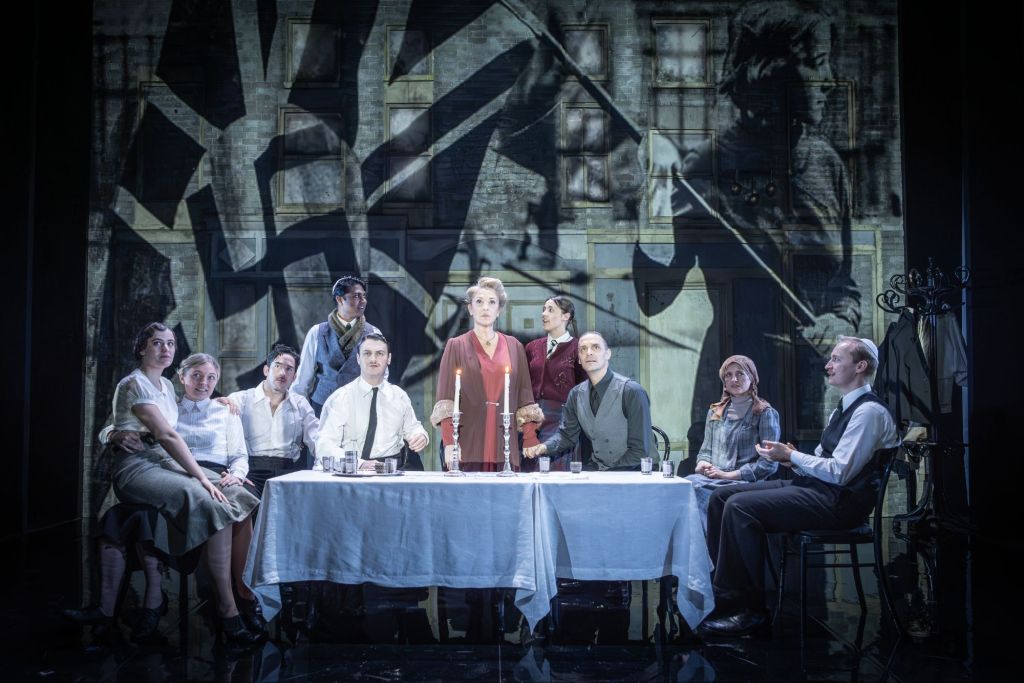
Oberman breaks character to recount an incident involving her family in which Oswald Mosely and his Blackshirts attempted a paramilitary march through the East End. She then describes how the neighbourhood united across different religions, races, and sexualities to oppose this group. She concludes her speech with the statement that unity makes us ‘stronger together’.
Rarely has Shakespeare’s work been adapted so powerfully or so profoundly as this.
Showing at Richmond Theatre 8th – 12th April 2025.
Tickets available at
https://www.atgtickets.com/shows/the-merchant-of-venice-1936/richmond-theatre/
Photo credit Marc Brenner.
4 stars
Reviewed by Nina Gardner.
Cast
Shylock Tracy-Ann Oberman
Antonio/Arragon Joseph Millson
Portia Georgie Fellows
Bassanio Gavin Fowler
Mary/Nerissa Evie Hargreaves
Jessica Gráinne Dromgoole
Gratiano/Police Constable Xavier Starr
Lorenzo/Maharajah Mikhail Sen
Blackshirt Alex Zur
Blackshirt Elly Roberts
Creatives
Adapted by Brigid Lamour and Tracy-Ann Oberman
Director Brigid Lamour
Associate Director Tracy-Ann Oberman
Costume & Set Designer Liz Cooke
Lighting Designer Rory Beaton
Composer Erran Baron Cohen
Sound Designer Sarah Weltman
Artistic Associates Annabel Arden & Richard Katz
Production Manager Matt Ledbury
Video Editor Greta Zabulyte






 Theatre, Art and Film Reviews
Leave a comment